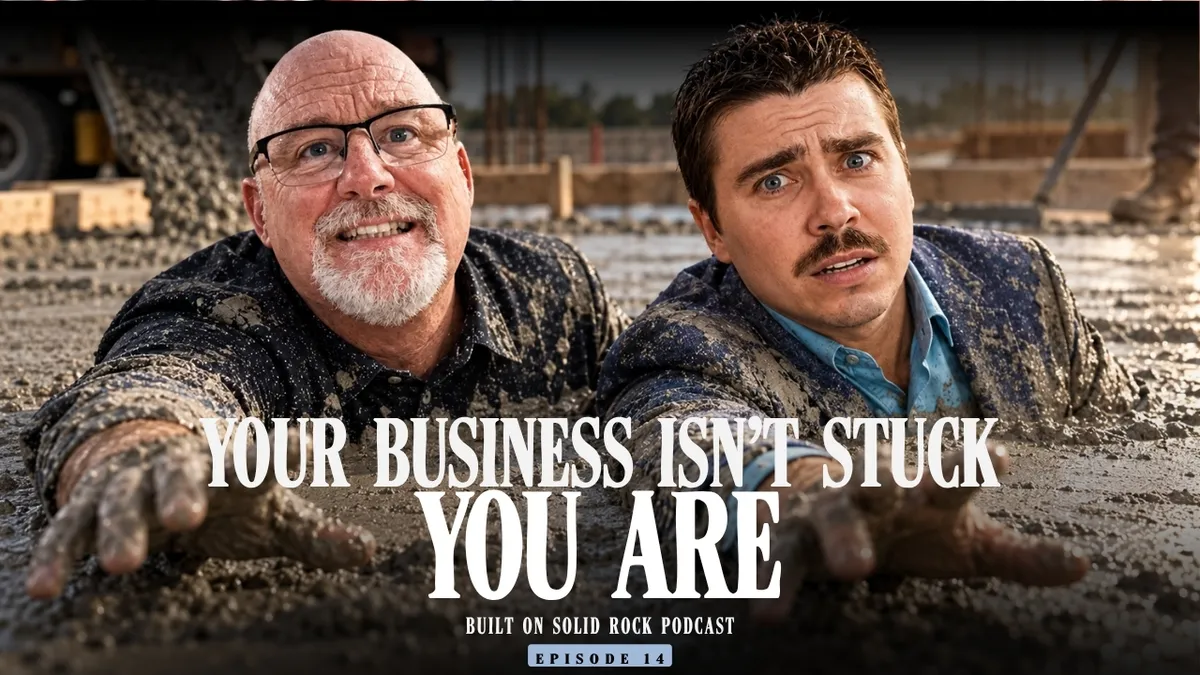
Your Business Isn’t Stuck. You Are.
Your Business Isn’t Stuck. You Are.
Built on Solid Rock Podcast | Episode 14
There is a phrase almost every business owner has used at some point: “We’re stuck.”
Revenue has plateaued. Growth has slowed. The team is not performing the way you expected. You cannot seem to find the right people. Customers are harder to land. Margins are tighter. What worked two years ago does not seem to work anymore.
When that happens, we naturally start looking for the reason. We blame the economy, the market, interest rates, our employees, our customers, our competitors, or the lack of qualified people available to hire.
Sometimes those things are absolutely real. Markets change. Industries change. Good employees can be difficult to find. Customers change their buying habits. Economic conditions create legitimate challenges.
But in Episode 14 of the Built on Solid Rock Podcast, we ask a much more uncomfortable question:
What if your business isn’t stuck? What if you are?
That question changes everything.
Your Business Can Only Grow as Far as You Are Willing to Grow
When you first start a business, hustle can cover a lot of weaknesses. You make the calls. You solve the problems. You land the customers. You handle the complaints. You make the decisions. You stay late. You get up early. You figure it out.
That kind of hustle is often necessary in the beginning. The problem comes when the business gets bigger, but the leader continues operating exactly the same way.
Suddenly there are more customers, more employees, more decisions, more money at risk, more problems, and more opportunities. There are also more people depending on you.
The leadership style that got you from zero to where you are today may not be the leadership style capable of taking you where you want to go next. That is where many entrepreneurs get stuck. They keep trying to grow the business without growing the person leading it.
The answer is not always another employee, another software platform, another marketing campaign, another salesperson, or another strategy. Sometimes the next breakthrough in your business begins with the person looking back at you in the mirror.
The Bottleneck Might Be You
This is difficult for entrepreneurs because we are wired to solve problems. When something is wrong, we look for the problem so we can fix it.
The danger is that we usually look outward first.
Why aren’t my employees performing? Why aren’t we generating enough sales? Why can’t we find better people? Why aren’t my managers taking ownership? Why does everything keep coming back to me?
Those are legitimate questions, but leaders also need to ask another question:
What am I doing that may be contributing to this?
Maybe your employees do not take ownership because you never really give it to them. Maybe your managers bring every problem to you because you have trained them that you will always provide the answer. Maybe your best people leave because you have not created room for them to grow.
Maybe sales have plateaued because you are still relying on relationships and methods that worked five years ago. Maybe nobody makes decisions without you because you have unintentionally built a company where every important decision requires your approval. Maybe you say you want growth, but you are unwilling to give up some of the control that growth requires.
That is a much harder conversation.
It is also where growth begins.
Stop Solving Every Problem
One of the easiest traps for a successful entrepreneur is becoming the answer machine.
An employee walks into your office with a problem. You know the answer, so you give it to them. Problem solved.
It feels efficient, and in that moment, it probably is. But what happens when you do that repeatedly?
You get better at solving problems. They get better at bringing problems to you.
Eventually, you become the bottleneck.
Strong leadership is not about demonstrating that you are the smartest person in the room. It is about developing people who can think, make decisions, solve problems, and eventually lead without constantly needing you.
Sometimes the best response to a question is another question.
What do you think we should do? What have you already tried? What are your options? What are we missing? If I wasn’t here, what decision would you make?
That approach can feel slower today, but it creates stronger people tomorrow. Stronger people create stronger businesses.
Your Comfort Zone Can Become Your Company’s Ceiling
Success creates another problem that we do not talk about enough. What worked becomes comfortable.
You know your industry. You know your customers. You have your processes. You have your routines. You know how you like things done.
Then the business changes. The market changes. Technology changes. Employees change. Customers change.
But you don’t.
Suddenly, the very experience that helped build the company can become the thing preventing the company from adapting.
Entrepreneurs love talking about innovation until innovation requires changing something that made them successful. That is the real test.
Growth requires asking, “What am I holding onto simply because it is familiar?”
There may be processes that need to disappear. There may be responsibilities you need to delegate. There may be conversations you have been avoiding. There may be technology you need to learn. There may be someone on your team who should be doing something you are still doing.
There may even be something you are very good at that you need to stop doing because it is no longer the best use of your time.
The question is not simply whether something worked in the past. The question is, “Will it take us where we are going?”
Busy Is Not the Same as Productive
This one can be particularly difficult for entrepreneurs because most of us know how to work.
We can fill a day with emails, meetings, phone calls, problems, employees, customers, paperwork, and decisions. You can work ten hours, feel exhausted at the end of the day, and still avoid doing the one thing that would have actually moved the business forward.
Activity feels productive because it is measurable. Growth, however, requires prioritization.
There is usually a relatively small number of things that actually move your business forward. It might be the difficult sales call, the leadership conversation you keep postponing, recruiting the right person, developing a manager, building a system, following up with the customer, making the decision, changing the process, saying no, or delegating something you should have stopped doing a year ago.
Sometimes your business is not stuck because you are not working hard enough.
You are working hard on the wrong things.
You Cannot Demand Ownership While Refusing to Give It
Business owners frequently say they want employees who think like owners.
Good. Then let them think.
Let them make decisions. Let them solve problems. Let them make some mistakes. Give them expectations. Give them accountability. Give them the information they need. Then give them enough room to own the result.
You cannot demand ownership while micromanaging every decision.
That does not mean abandoning standards. It means creating clear standards and developing people who are capable of operating within them.
If you want leaders, you have to let people lead. That means your role changes.
You move from doing everything to developing people. You move from providing every answer to asking better questions. You move from controlling every decision to creating clarity. You move from being needed everywhere to building a business that does not require you everywhere.
That is growth.
Your Business Problems May Actually Be Leadership Problems
Sometimes what looks like a sales problem is actually a leadership problem. What looks like an employee problem is actually a communication problem. What looks like a motivation problem is actually a clarity problem.
What looks like a hiring problem may actually be a culture problem. What looks like an accountability problem may actually be an expectations problem.
Sometimes what looks like a business problem is actually a you problem.
That should not be viewed as condemnation. It should be viewed as opportunity.
If you are part of the problem, you can also become part of the solution.
That is far more empowering than believing your future is entirely controlled by the economy, your competitors, your employees, or circumstances you cannot influence.
Ask a Better Question
Instead of constantly asking, “Why isn’t my business growing?” ask, “How do I need to grow for my business to grow?”
Instead of asking, “Why won’t my people take more ownership?” ask, “What am I doing to develop ownership?”
Instead of asking, “Why does everybody need me?” ask, “What have I built that makes everybody need me?”
Instead of asking, “Why aren’t my leaders leading?” ask, “Am I actually developing leaders?”
Instead of asking, “Why are we still doing this?” ask, “What am I unwilling to change?”
Those questions require humility. They also create possibilities.
Growth Starts With Ownership
At Solid Rock Recruiting, one of the ideas we continually come back to is ownership.
You cannot control everything that happens to you. You cannot control the economy. You cannot control every client. You cannot control every employee. You cannot control your competition.
But you can control how you respond.
You can learn. You can change. You can have the difficult conversation. You can improve the system. You can develop your people. You can become more disciplined. You can ask for help. You can admit that something that once worked no longer works. You can make a different decision tomorrow than you made yesterday.
That is where ownership becomes powerful.
The moment you stop asking only what everyone else needs to change and start asking what you need to change, you regain influence over the future.
The Next Level Requires a Different Version of You
Every new level of business exposes something. It may expose a weakness, a blind spot, a bad habit, a skill you have not developed, a conversation you have avoided, or a responsibility you have refused to release.
That is not necessarily evidence that you are failing. It may simply be evidence that you have reached the edge of your current capacity.
Now you have a choice.
You can retreat to what is comfortable. You can blame circumstances. You can keep doing more of what you have always done.
Or you can grow.
You can learn something new. Ask better questions. Develop better people. Build better systems. Become more disciplined. Listen more. Delegate. Get uncomfortable again.
The next version of your business may require the next version of you.
Your Business Isn’t Stuck. You Are.
That statement is intentionally uncomfortable. Entrepreneurship has a way of exposing us.
But there is also tremendous freedom in recognizing that some of the things holding our businesses back are things we can actually change.
Before you restructure the company, buy another piece of software, blame your employees, fire your salesperson, increase the marketing budget, change your compensation plan, or decide the market is dead, spend some time looking inward.
Ask yourself where you have become the bottleneck. Ask what you are avoiding. Ask what you are holding onto that you need to release. Ask what you need to learn. Ask who you need to develop. Ask what conversation you need to have. Ask what behavior needs to change.
Then ask the biggest question of all:
Who do I need to become for this business to become what I believe it can be?
Your business may not need another strategy nearly as much as it needs a growing leader.
Build the leader. Build the people. Build the business.
That is what we discuss in Episode 14 of the Built on Solid Rock Podcast, “Your Business Isn’t Stuck. You Are.”
