
Table of Contents
- Why Your Hiring Process Is Slower Than It Needs to Be
- Step 1: Audit Your Hiring Process Bottlenecks
- Step 2: Map the Recruitment Process Steps That Actually Matter
- Step 3: Build a Realistic Hiring Process Timeline
- Step 4: Fix Job Descriptions and Sourcing to Speed Up Hiring
- Step 5: Master Candidate Communication During Hiring
- Step 6: Compress Interviews and Decision-Making Without Cutting Corners
- Conclusion: Speed Is a Process Problem, Not a Talent Problem
- Frequently Asked Questions
Last Updated: October 19, 2026
Why Your Hiring Process Is Slower Than It Needs to Be
Your open project manager seat has been vacant for six weeks. Your team is covering, but the cracks are showing. Meanwhile, the best candidates in your market already have jobs and are not reading your posting.
Here is the hard truth we share with clients at Solid Rock Recruiting: most hiring delays have nothing to do with a talent shortage. They come from your own process. Extra approval steps. Slow feedback loops. Panels that cannot agree on a calendar.
Below, we break down seven steps that compress a slow hiring process into a tight, fair, and decisive one. No gimmicks. Just the work.
Step 1: Audit Your Hiring Process Bottlenecks
A hiring process bottleneck is any step where a candidate waits on you longer than you wait on them. Find those steps and you have found your lost weeks.
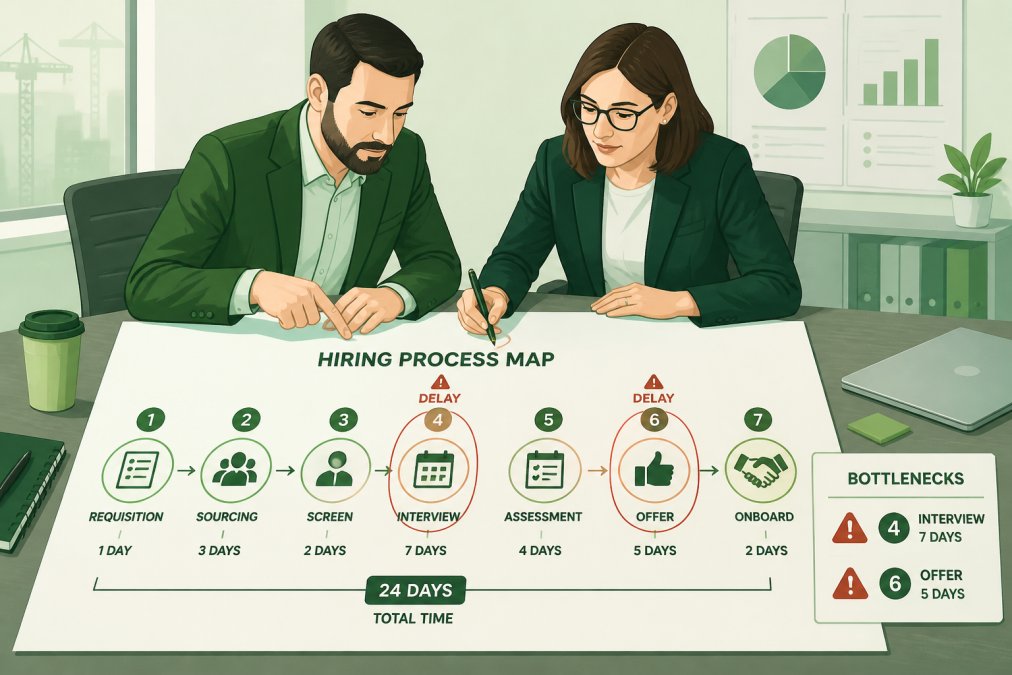
Pull your last five hires and map every stage from application to signed offer. For each stage, ask three questions:
- Who owns this step?
- How long did it actually take?
- Did it change the outcome?
Most teams find two or three steps that add days but no real signal. A second screening call that repeats the first. A panel interview where one person always abstains.
A common mistake is auditing the process you designed instead of the process people actually use. Shadow one live search. You will see the real delays.
Step 2: Map the Recruitment Process Steps That Actually Matter
The recruitment process steps that actually matter are the ones that predict performance: a real skills conversation, a structured interview, and a clear offer. Everything else is optional.
We recommend a five-stage map for most roles:
- Sourcing and outreach (recruiter or hiring manager)
- Screening call (recruiter, 20 to 30 minutes)
- Structured interview (hiring manager, same questions for every candidate)
- Focused panel or site visit (only people who will work with the hire)
- Offer and close (hiring manager plus one approver)
Notice what is missing. No take-home project for senior people with full-time jobs. No fourth interview. No "quick chat" with someone who has no say.
For a litigation attorney or a construction estimator, the structured interview does the heavy lifting. You are testing judgment, client skill, and how they think on their feet. A long process does not test that better. It just tests patience.
Step 3: Build a Realistic Hiring Process Timeline
A hiring process timeline sets a target date for every stage before the search starts, names the owner of each stage, and defines what "done" looks like at each handoff.
Before you build the timeline, agree on how you will measure speed. Three metrics do most of the work:
- Time to fill. Days from requisition approval to accepted offer. This is the number your leadership cares about.
- Time to hire. Days from first candidate contact to accepted offer. This tells you how fast your process moves once a real candidate is in it.
- Stage conversion and stage duration. How many candidates move from each stage to the next, and how many days each stage takes. This is where you find the bottleneck.
A common pattern: time to fill looks terrible, but time to hire is fine. That means the delay is upstream, in approval or sourcing, not interviewing.
Set targets by role, not by wishful thinking. A high-volume field role and a partner-level legal search should not share a timeline. Here is a starting framework we use with clients, adjusted to the role:
| Stage | Target Time | Owner | Service-Level Expectation |
|---|---|---|---|
| Role intake and scorecard | Day 1-2 | Hiring manager | Scorecard signed off before sourcing begins |
| Sourcing and outreach | Day 2-10 | Recruiter | First qualified slate presented within 5 business days |
| Screening calls | Day 5-12 | Recruiter | Candidate feedback to hiring manager within 24 hours |
| Structured interviews | Day 10-18 | Hiring manager | Interview scheduled within 3 business days of slate approval |
| Panel or site visit | Day 15-22 | Team | All panelists submit scorecards within 24 hours of interview |
| Debrief and decision | Day 18-24 | Hiring manager | Decision within 48 hours of last interview |
| Offer and close | Day 20-28 | Hiring manager plus one approver | Verbal offer within 48 hours of decision; written offer same day |
That keeps most searches inside four weeks and exposes the real bottleneck early. If your panel cannot meet within a week of the final interview, you do not have an interview problem.
Adapt the timeline to the role instead of forcing one process onto every vacancy:
- Senior and executive roles. Add a stage for references and a deeper conversation with the hiring executive, but keep decision deadlines firm. Senior candidates have the most options and the least patience for drift.
- Regulated and licensed roles. Build in time for license verification and background checks, and start them in parallel with the final interview, not after the offer.
- Technical and specialized roles. A focused work sample can replace a fourth interview, but schedule it inside the timeline rather than letting it float.
- High-volume roles. Batch screening and interview days compress calendar time. Group candidates into cohorts so the hiring manager reviews a slate, not a trickle.
Write the timeline down, share it with every participant, and review it against actuals after each hire. A timeline you never measure is just a hope.
Step 4: Fix Job Descriptions and Sourcing to Speed Up Hiring
Speed up hiring by fixing the two things that control your candidate pipeline: the job description and where you look for people.
Most job descriptions read like a wish list. Fifteen bullet points, half of them nice-to-haves, none ranked. Strong candidates skip them. Weak candidates apply anyway, and your screening pile gets worse.
Rewrite for signal:
- Lead with the outcome, not the duties ("You will run commercial drywall projects from award to closeout")
- List five must-have qualifications, not fifteen
- State the compensation range and location reality
- Cut every phrase a candidate has read a thousand times
Then widen your sourcing. Job boards catch active applicants. Referrals and direct outreach reach professionals who are already employed and not looking.
This is where a specialized recruiting partner earns its keep. You can see the full scope of what we do on our Services page, and candidates who want to be found before they start looking can browse our Jobs page.
Step 5: Master Candidate Communication During Hiring
Candidate communication during hiring is the cheapest speed lever you have. Fast, clear updates keep strong candidates engaged and stop them from taking another offer while you decide.
The rule is simple: no candidate should ever wonder where they stand. Send a short update after every stage, even when there is nothing new.
Use templates so it takes minutes, not hours:
After screening: "Thanks for the conversation today. You are moving to the next round. We are scheduling the interview for [date range]. I will confirm the exact time within two business days."
After the final interview: "You are through the final round.
When there is a delay: "We are running two days behind on the decision. You are still in the running, and I will update you by [date]."
Two things make this work. Commit to a date and keep it. And call, do not just email. A five-minute call closes more candidates than ten emails.
Step 6: Compress Interviews and Decision-Making Without Cutting Corners
You can shorten the interview process and still hire well. Cut repetition, not rigor, and fix the stage where speed quietly dies: the offer.
Start with the interview loop itself.
- Consolidate interviews. Run the screening call and the first structured interview on the same day when possible. Two conversations, one trip, one calendar block.
- Use one scorecard. Every interviewer scores the same core criteria on a simple scale before the debrief. Compare scores, not impressions. A scorecard written before the interview is the difference between a decision and an argument.
- Set a decision deadline before interviews start. The hiring manager commits to a decision within 48 hours of the last interview. Put the date on the calendar.
- Limit the panel. Only people who will work directly with the hire get a vote. Everyone else gets an update, not a meeting.
- Keep the slate fair and fast. Structured questions, consistent scorecards, and same-day debriefs make decisions faster and fairer. A diverse slate of qualified candidates, evaluated against the same criteria, protects you from a rushed gut call that you cannot defend later.
Then fix the offer stage, because that is where most searches lose the candidate they wanted.
Align compensation before the final interview. Ask for expectations early, confirm the range with the hiring manager, and know your walk-away number.
Map the approval path before you interview anyone. Write down every signature required to extend an offer and how long each one takes.
Plan for the counteroffer. Assume the candidate's current employer will counter.
Adapt the approach to the role.
Conclusion: Speed Is a Process Problem, Not a Talent Problem
The fastest hiring teams are not lucky. They removed the steps that added days without adding signal. They wrote a timeline and kept it. They communicated like professionals and decided like adults.
That is the whole lesson on how to speed up hiring process outcomes: fix your process, and the talent shows up on time.
If you want a partner who understands your market and moves with urgency, we can help. Our specialized recruiters in construction, legal, and public accounting build real relationships, give honest feedback, and do the disciplined work to connect great people with great companies.
Let's build a stronger team. Call us at 605.223.0219 or visit our client services page to start the conversation.
Frequently Asked Questions
How long should a hiring process take?
For most professional and skilled-trade roles, a well-run process takes 3 to 5 weeks from first contact to accepted offer. Construction project managers, litigation attorneys, and senior CPAs often need 4 to 6 weeks because top candidates are employed and need time to evaluate a move. If your process routinely runs past 6 weeks, the delay is usually in scheduling, approvals, or offer-stage hesitation, not in the candidate pool. Map your hiring process timeline and you will see where the days disappear.
How can you speed up hiring without lowering the quality of hires?
Remove steps that do not predict performance, not steps that do. A 15-minute recruiter screen, a structured interview with the hiring manager, and one technical or panel interview usually tell you more than five unstructured conversations. Define must-have criteria before you post the role, use the same questions for every candidate, and give interviewers 24 hours to submit feedback. You speed up hiring by cutting coordination drag, not by skipping diligence.
What are the most common hiring process bottlenecks?
The usual culprits: slow internal approvals on the job requisition, interviewers who cannot find a shared slot, hiring managers who wait days to review résumés, and offer-stage hesitation. Another frequent bottleneck is unclear job descriptions that attract unqualified applicants, which forces more screening. Audit each step and ask how many business days it adds. Fix the three slowest steps first and you will often cut two weeks without touching your standards.
How do you keep candidates engaged during a long hiring process?
Communicate on a schedule, not when you remember. Send a status update every 3 to 5 business days, even if the update is that nothing has changed. Tell candidates the timeline upfront and name the next step and date. If a delay is coming, say so before they have to ask. Top candidates in construction, legal, and public accounting are usually employed and juggling their own deadlines. Silence reads as disinterest, and disinterest loses good people.